Thyme to soothe your autumn cold
The change of season arrives: warm summer days become darker, sharper wind, colder air, autumn sets in… On a rainy morning, you wake up feeling unwell. Your breathing feels heavier, your chest full, sneezing and coughing. A mild cold with a chesty cough has caught up with you. What you may not realise is that amongst your kitchen spices sits a gentle and helpful remedy: thyme.
A common cold is a viral, self-limiting inflammation of the upper respiratory tract, with symptoms of sore throat, sneezing, blocked or runny nose, headache, cough and sometimes a low-grade fever (BMJ Best Practice, 2026). What does this all mean? “Self-limiting” means it usually clears up on its own. A cold starts in the nose and throat, but can also settle on the chest and bring phlegm, protecting your airways, trapping viruses and bacteria so they can be carried out of the body (National Institutes of Health, 2020).
How can thyme help?
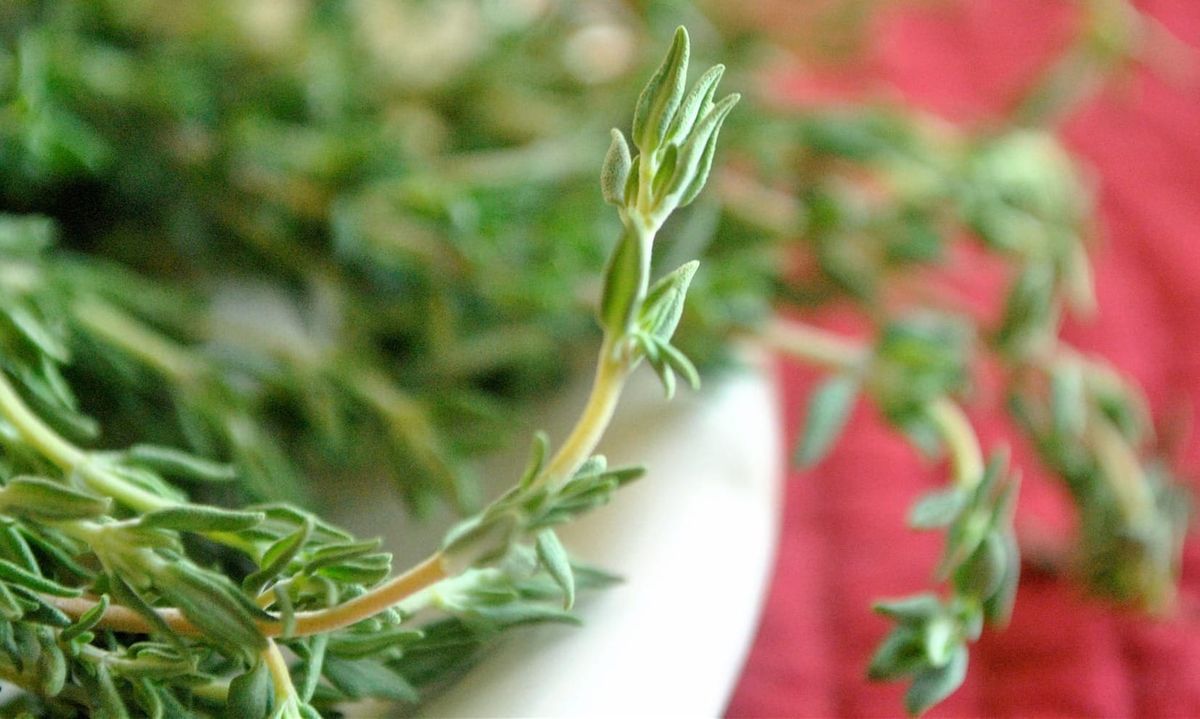
Common or garden thyme (Thymus vulgaris L.) is a member of the Lamiaceae family, known for aromatic herbs rich in volatile oils. Traditionally, leaves, stalks and flowers of thyme are used. Common thyme grows in the Western Mediterranean and extends to South-Eastern Italy (Chevallier, 2023; Waheed et al., 2024). Thyme’s name comes from the Greek, meaning “to fumigate or disinfect”, a connection to its strong aroma (Dauqan & Abdullah, 2017). Its volatile oils, thymol and carvacrol, travel through the respiratory and digestive tracts, bringing antibacterial, antiviral and expectorant actions, reducing coughs and throat pain, supporting the lungs in bringing more oxygen in while getting phlegm out (Chevallier, 2023; Menzies-Trull, 2022).
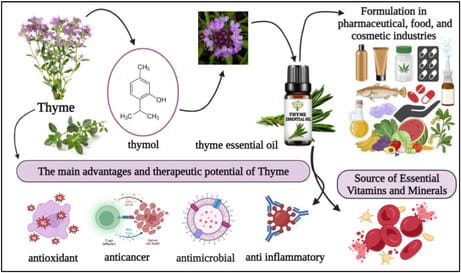
For a chesty cold, thyme acts as an expectorant, thinning phlegm and speeding up the hair-like bronchial cilia, which sweep mucus up the respiratory tract; as an antispasmodic, relaxing airway muscles and calming coughing fits; as an antimicrobial, fighting bacteria and viruses; and as an anti-inflammatory, calming swelling and irritation in the airways (Waheed et al., 2024). These actions are coordinated by thymol (Figure 2), carvacrol and the flavonoids (Menzies-Trull, 2022). A clinical trial on acute bronchitis showed a combined thyme and ivy (Hedera helix L.) extract reduced coughing fits by 68.7% compared with 47.6% for placebo (Kemmerich et al., 2006).
Thyme is a versatile herb: it can be used fresh in cooking or as a honey infusion, syrup, herbal infusion, tincture or diluted oil (Chevallier, 2023; Menzies-Trull, 2022).
Attention to safety
Thyme should be avoided in large quantities, during pregnancy and by small children, its essential oil must always be diluted (Waheed et al., 2024). Symptoms such as difficulty breathing, high fever or signs of whooping cough need medical care. People taking medication must first consult a GP .
Widely cultivated and unthreatened (Khela, 2014), thyme grows easily at home from cuttings (Royal Horticultural Society, 2025). When sourcing thyme, consider organic options.
Learn More
Before beginning herbal care, I invite you to consider your safety and medications. Trained by Betonica, School of Herbal Medicine, I offer personalised consultations and care. Join my newsletter and follow me on @sanctiapothecary, @betonicaschoolofherbalmedicine and the National Institute of Medical Herbalists on Instagram to learn more about herbal medicine.
References
BMJ Best Practice. (2026). Common cold. https://bestpractice.bmj.com/topics/en-gb/252
Chevallier, A. (2023). Encyclopedia of herbal medicine (4th ed.). Dorling Kindersley.
Dauqan, E. M., & Abdullah, A. (2017). Medicinal and functional values of thyme (Thymus vulgaris L.) herb. Journal of Applied Biology & Biotechnology, 5(2), 17–22.
Kemmerich, B., Eberhardt, R., & Stammer, H. (2006). Efficacy and tolerability of a fluid extract combination of thyme herb and ivy leaves and matched placebo in adults suffering from acute bronchitis with productive cough. Arzneimittel-Forschung, 56(9), 652–660.
Khela, S. (2014). Thymus vulgaris. The IUCN Red List of Threatened Species 2014, e.T203348A2764289. https://doi.org/10.2305/IUCN.UK.2014-1.RLTS.T203348A2764289.en
Menzies-Trull, C. (2022). Herbal medicine keys to physiomedicalism including pharmacopoeia (3rd ed.). Faculty of Physiomedical Herbal Medicine.
National Institutes of Health. (2020, August). Marvels of mucus and phlegm: The slime that keeps you healthy. NIH News in Health. https://newsinhealth.nih.gov/2020/08/marvels-mucus-phlegm
Royal Horticultural Society. (2025). Thyme. https://www.rhs.org.uk/herbs/thyme/grow-your-own
Waheed, M., Hussain, M. B., Saeed, F., Afzaal, M., Ahmed, A., Irfan, R., Akram, N., Ahmed, F., & Hailu, G. G. (2024). Phytochemical profiling and therapeutic potential of thyme (Thymus spp.): A medicinal herb. Food Science & Nutrition, 12, 9893–9912. https://doi.org/10.1002/fsn3.4563
Figures list
cookbookman17. (2011, September 6). Fresh thyme [Photograph]. Flickr. https://www.flickr.com/photos/cookbookman/6121426302/
Waheed, M., Hussain, M. B., Saeed, F., Afzaal, M., Ahmed, A., Irfan, R., Akram, N., Ahmed, F., & Hailu, G. G. (2024). Phytochemical profiling and therapeutic potential of thyme (Thymus spp.): A medicinal herb. Food Science & Nutrition, 12, 9893–9912. https://doi.org/10.1002/fsn3.4563